(わざ)
skill, craft, technique
(つたえる)
to convey / to tell
(とりくみ)
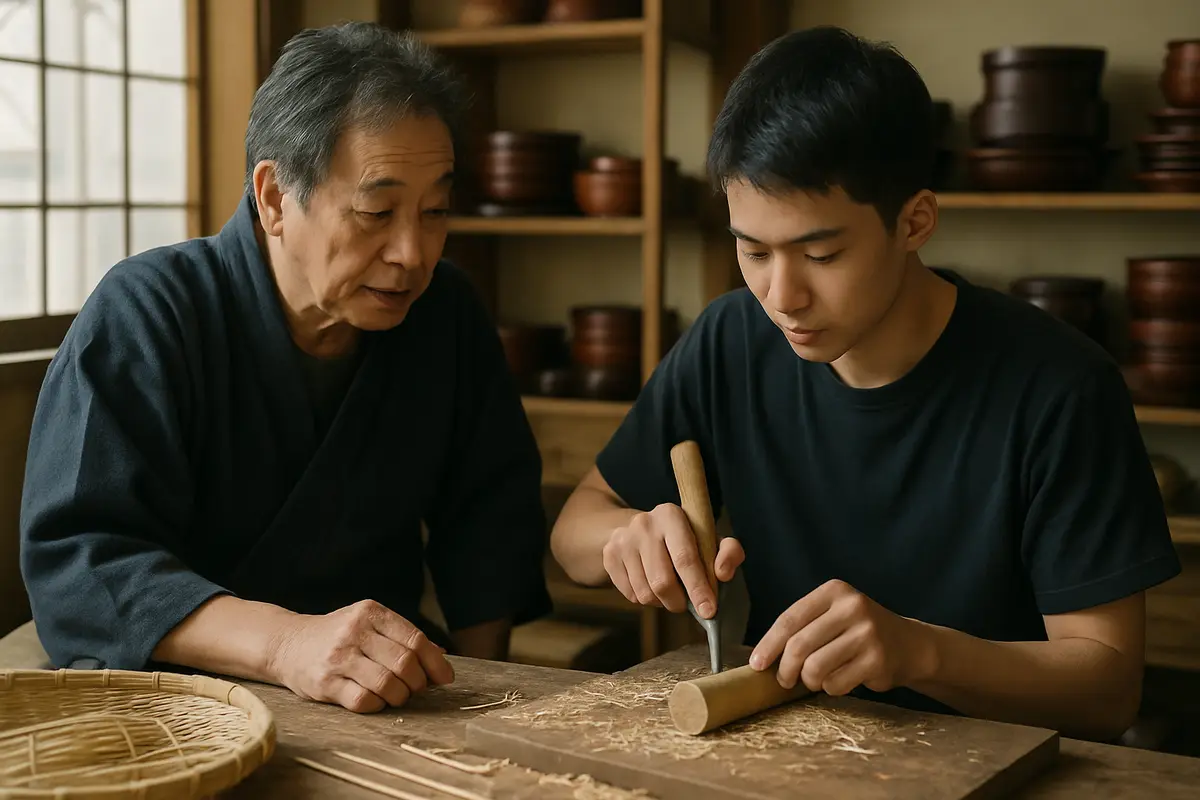
efforts, initiatives
(かくち)
various places, everywhere
(しょくにん)
craftsman / artisan
(こうれいか)
ageing (of a population)
(むかえる)
to go meet, welcome
(くに)
country; the government
(ちょうさ)
investigation; survey
(さんち)
producing region, place of origin
(へる)
to decrease / to diminish
(うけつぐ)
to inherit, to take over
(たりる)
to be enough; to be sufficient
(かだい)
issue, problem, challenge
(くみあい)
association, union, cooperative
(そだてる)
to raise, to bring up, to grow
(けんしゅうせい)
trainee, apprentice
(ぼしゅう)
recruitment, invitation to apply
(しえん)
support; aid; assistance
(おもしろい)
interesting; funny
(さくひん)
work (of art), piece
(こうりゅう)
exchange, interaction
(しょうかい)
introduction, presentation
(ふえる)
to increase; to grow
(ただし)
however, provided that
(ねんげつ)
years, the passage of time
(かかる)
to take (time/money), cost
(ざいりょう)
materials, ingredients
(けいえい)
management, operations
(せんもんか)
expert, specialist
(ふやす)
to increase (something)
(くふう)
ingenuity; device; scheme
(してき)
pointing out, indication
by means of / through
Expresses the means by which something is achieved — through sport, everyone can live together.
スポーツによって一緒に生きていけます。
Through sports we can live together.
インターネットによって情報が広がります。
Information spreads via the Internet.
is doing, has been doing (ongoing state/action)
Expresses a continuing action or resulting state. Formed with て-form + いる. Can describe an action in progress or a state resulting from a past change.
今、ご飯を食べています。
I am eating rice now.
東京に住んでいます。
I live in Tokyo.
ドアが開いています。
The door is open.
according to ...
Cites a source of information. The noun before によると is the source. Often followed by a reported statement.
天気予報によると、明日は雨です。
According to the weather forecast, it will rain tomorrow.
ニュースによると、地震がありました。
According to the news, there was an earthquake.
先生によると、テストは来週です。
According to the teacher, the test is next week.
compared to ~
Noun + と比べて is used to make comparisons. Used here to compare Q3 GDP to Q2.
4月から6月までと比べて、マイナス0.4%でした。
Compared to April–June, it was -0.4%.
去年と比べて、暑いです。
Compared to last year, it is hot.
nominalizer (the act of ~)
Turns verbs into nouns — changing one's awareness (意識を変えること), not over-buying (買いすぎないこと), and using leftovers well (使うこと).
話すことが大切だ。
Talking is important.
while doing ...
Verb stem + ながら indicates doing two things simultaneously. The action before ながら is the secondary action; the main action follows.
音楽を聞きながら勉強します。
I study while listening to music.
歩きながら話しましょう。
Let's talk while walking.
テレビを見ながらごはんを食べます。
I eat while watching TV.
quotative particle
Marks the content of what someone said or reported. Used with 言う here.
彼は行くと言いました。
He said he would go.
明日休みだと聞きました。
I heard tomorrow is a holiday.
upon doing ~ / when ~ was done
Describes the result after performing an action: 雄の花の芽を調べたところ (upon examining the male flower buds).
環境省が杉の雄の花の芽を調べたところ、26の道府県で平均より多くなりました。
When the Ministry of the Environment examined cedar male flower buds, they found that 26 prefectures exceeded the average.
by the time ~ / before ~
までには marks the point by which something must be reached; here it measures the long apprenticeship needed before a maker can go independent.
独立できるまでには長い年月がかかります。
It takes many years before you can go independent.
帰るまでには終わらせます。
I will finish it before I go home.
Is not ~
Polite negative form of です. Used to negate a noun or na-adjective predicate. The price is not yet affordable.
学生ではありません。
I am not a student.
in order to ~
Expresses what is necessary in order to sell cars in America.
アメリカで車を売るためには、新しいアイデアが必要です。
In order to sell cars in America, new ideas are necessary.
1
伝統工芸の技を若者に伝える取り組み
Efforts to pass the skills of traditional crafts on to young people
2
日本各地の伝統工芸が、職人の高齢化によって難しい時期を迎えています。
Traditional crafts across Japan are facing a difficult period because their artisans are growing old.
3
国の調査によると、産地で工芸の仕事をする人の数は、30年前と比べて大きく減りました。
According to a national survey, the number of people working in crafts in the producing regions has fallen sharply compared with 30 years ago.
4
技術を受け継ぐ若い世代が足りないことが、最も大きな課題です。
The biggest problem is that there are not enough young people to take over the techniques.
5
そこで、産地の組合が若者を育てる取り組みを始めています。
In response, craft associations in the producing regions have begun initiatives to train young people.
6
ある県では、漆器の工房が研修生を募集し、生活費を支援しながら技術を教えています。
In one prefecture, a lacquerware workshop recruits trainees and teaches them the craft while supporting their living costs.
7
参加した20代の女性は「手で作る仕事の面白さを知りました」と話しました。
A woman in her twenties who took part said, "I discovered how interesting it is to make things by hand."
8
作品を交流サイトで紹介したところ、注文が増えた工房もあります。
There are also workshops whose orders increased after they showcased their pieces on social media.
9
ただし、独立できるまでには長い年月がかかります。
That said, it takes many years before a trainee can set up on their own.
10
材料の値上がりも続いていて、経営は簡単ではありません。
Material prices also keep rising, and running the business is not easy.
11
専門家は「作り手を支えるためには、買う人を増やす工夫も必要だ」と指摘しています。
An expert points out, "To support the makers, we also need clever ways to increase the number of buyers."
Discussion
to rate or comment.
No comments yet.