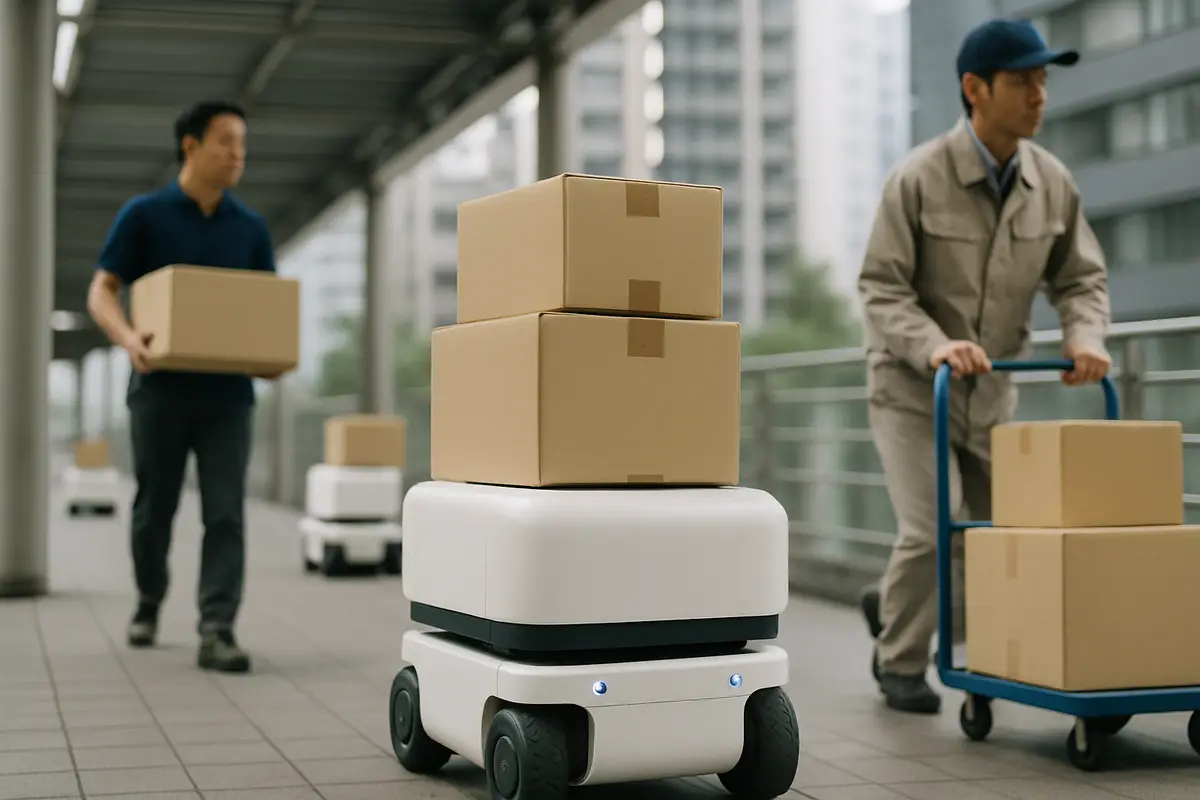
日本の町で、荷物を運ぶロボットが増えています2。ロボットは小さくて、車のような形です3。人が歩く道をゆっくり走ります4。買った物や食べ物を家まで運びます5。
このロボットを使う会社が多くなりました6。荷物を運ぶ人が足りないからです7。ロボットが手伝うと、人の仕事が少し楽になります8。
ロボットは人にぶつからないように、カメラで前を見ます9。人が近くにいるとき、止まります10。安全のために、会社は毎日ロボットを調べます11。これからもっと多くの町で、ロボットが荷物を運ぶでしょう12。
(にほん)
Japan
(まち)
town
(にもつ)
luggage; package; cargo
(はこぶ)
to carry; to transport
(ろぼっと)
robot
(ふえる)
to increase; to grow
(ちいさい)
small
(くるま)
car
(かたち)
shape, form
(ひと)
person / people
(あるく)
to walk
(みち)
road, street, path
(ゆっくり)
slowly, at ease, peacefully
(はしる)
to run
(かう)
to buy
(もの)
thing
(たべもの)
food
(いえ)
house
(つかう)
to use
(かいしゃ)
company
(おおい)
many
(たりる)
to be enough; to be sufficient
(てつだう)
to help
(しごと)
work, job
(すこし)
a little
(らく)
ease; comfort
(ぶつかる)
to crash into, to collide
(かめら)
camera
(まえ)
before, previous
(みる)
to see, watch
(ちかく)
nearby
(とまる)
to stop
(あんぜん)
safety
(まいにち)
every day
(しらべる)
to investigate; to survey
(もっと)
more / further
is doing, has been doing (ongoing state/action)
Expresses a continuing action or resulting state. Formed with て-form + いる/います. Can describe an action in progress or a state that continues from a past change.
今、本を読んでいます。
I am reading a book now.
窓が開いています。
The window is open.
日本に住んでいます。
I live in Japan.
~ and (i-adjective connector)
The て-form of i-adjectives, used to connect two adjectives or to give a reason. Formed by replacing い with くて.
この部屋は広くて明るいです。
This room is spacious and bright.
like ~ / similar to ~
Used in ゲームのようにリハビリができる ('can do rehab like a game') to describe game-like therapy machines.
雪のような白い肌。
Skin as white as snow.
夢のような話。
A dream-like story.
until / as far as
Indicates an end point in space or time. Here it expresses how far the balls flew.
駅まで歩きます。
I walk to the station.
遠くまで飛びました。
It flew far away.
to become (い-adjective)
Expresses a change of state for い-adjectives. Drop the final い and add くなる. Indicates something has changed or will change to a new state.
寒くなりました。
It has gotten cold.
日本語が上手になりました。
My Japanese has gotten better.
値段が高くなりました。
The price became expensive.
because ~
Provides a reason or cause.
疲れたから休む。
I'll rest because I'm tired.
寒いから帰る。
I'm going home because it's cold.
if / when (natural consequence)
Conditional と indicating a natural or expected result. 一緒に捨てると…火が出て means 'if you throw them away together, fire starts.'
ボタンを押すと、ドアが開きます。
When you press the button, the door opens.
春になると、桜が咲きます。
When spring comes, cherry blossoms bloom.
to become
Expresses a change of state; Kawai became the new commissioner of the Sports Agency.
新しい長官になりました。
He became the new commissioner.
目が見えなくなりました。
He became unable to see.
so that ... not, in order to prevent
Expresses a negative purpose - doing something so that something else does NOT happen. Formed with verb negative form + ように.
忘れないようにメモしました。
I took notes so I wouldn't forget.
遅れないように早く出ました。
I left early so I wouldn't be late.
風邪をひかないように気をつけてください。
Please be careful not to catch a cold.
when ~
Indicates the time when something happened — when he was in junior high school.
中学生のとき病気になりました。
When I was a junior-high student I got sick.
子どものとき日本にいました。
I was in Japan when I was a child.
for the purpose of / in order to
Used in テストのために ('for the purpose of testing') to explain why the E8 train was running.
健康のために運動します。
I exercise for my health.
仕事のために東京に行く。
I go to Tokyo for work.
Probably ~; it seems that ~
Expresses conjecture or probability. More formal than ~だろう. Often used in news and weather reports.
明日は雨が降るでしょう。
It will probably rain tomorrow.
荷物を運ぶロボットが増える
Robots that deliver packages are on the rise
日本の町で、荷物を運ぶロボットが増えています。
In towns across Japan, robots that carry packages are increasing.
ロボットは小さくて、車のような形です。
The robots are small and shaped like little cars.
人が歩く道をゆっくり走ります。
They travel slowly along the paths where people walk.
買った物や食べ物を家まで運びます。
They carry purchases and food all the way to people's homes.
このロボットを使う会社が多くなりました。
The number of companies using these robots has grown.
荷物を運ぶ人が足りないからです。
That is because there are not enough people to deliver packages.
ロボットが手伝うと、人の仕事が少し楽になります。
When the robots help out, people's work becomes a little easier.
ロボットは人にぶつからないように、カメラで前を見ます。
So that they do not bump into people, the robots watch ahead with a camera.
人が近くにいるとき、止まります。
When someone is nearby, they stop.
安全のために、会社は毎日ロボットを調べます。
For safety, the companies inspect the robots every day.
これからもっと多くの町で、ロボットが荷物を運ぶでしょう。
From now on, robots will probably deliver packages in even more towns.
2026年08月21日 19:18
著者: jpreader
この画像はAIで生成され、学習目的で使用されています。
This image is AI-generated and used for educational purposes.
日本の町で、荷物を運ぶロボットが増えています2。ロボットは小さくて、車のような形です3。人が歩く道をゆっくり走ります4。買った物や食べ物を家まで運びます5。
このロボットを使う会社が多くなりました6。荷物を運ぶ人が足りないからです7。ロボットが手伝うと、人の仕事が少し楽になります8。
ロボットは人にぶつからないように、カメラで前を見ます9。人が近くにいるとき、止まります10。安全のために、会社は毎日ロボットを調べます11。これからもっと多くの町で、ロボットが荷物を運ぶでしょう12。
Discussion
to rate or comment.
No comments yet.