日本のスーパーやコンビニで、セルフレジが増えています2。セルフレジは、客が自分で商品の値段を機械に入れて、お金を払うレジです3。店の人はレジに立ちません4。
店がセルフレジを使う理由は、働く人が足りないからです5。日本では若い人が少なくなっています6。セルフレジがあると、少ない人で店を開けることができます7。
しかし、問題もあります8。お年寄りには、機械の使い方が難しいです9。ですから、店の人が近くにいて、使い方を教えます10。これから、もっと簡単なセルフレジが必要です11。
(せるふれじ)
self-checkout register
(みせ)
shop, store
(ふえる)
to increase; to grow
(にほん)
Japan
(すーぱー)
supermarket
(こんびに)
convenience store
(きゃく)
Customer; guest
(じぶん)
oneself
(しょうひん)
goods; merchandise; product
(ねだん)
price
(きかい)
machine
(いれる)
to put in
(おかね)
money
(はらう)
to pay
(れじ)
cash register, checkout
(ひと)
person / people
(たつ)
to stand
(つかう)
to use
(りゆう)
reason; cause
(はたらく)
to work
(たりる)
to be enough; to be sufficient
(わかい)
young
(すくない)
few, scarce
(ある)
a certain (some)
(あける)
to open
(しかし)
however, but
(もんだい)
problem
(おとしより)
elderly person
(つかいかた)
how to use; usage
(むずかしい)
difficult
(ですから)
therefore; for that reason
(ちかく)
nearby
(おしえる)
to teach
(これから)
from now on
(もっと)
more / further
(かんたん)
simple / easy
(ひつよう)
necessary / needed
is doing, has been doing (ongoing state/action)
Expresses a continuing action or resulting state. Formed with て-form + いる. Can describe an action in progress or a state resulting from a past change.
今、ご飯を食べています。
I am eating rice now.
東京に住んでいます。
I live in Tokyo.
ドアが開いています。
The door is open.
does not ~ (polite negative)
ません is the polite negative form of verbs. It negates the action in a formal/polite context.
今日は学校に行きません。
I won't go to school today.
because ~
Provides a reason or cause.
疲れたから休む。
I'll rest because I'm tired.
寒いから帰る。
I'm going home because it's cold.
to become (い-adjective)
Expresses a change of state for い-adjectives. Drop the final い and add くなる. Indicates something has changed or will change to a new state.
寒くなりました。
It has gotten cold.
日本語が上手になりました。
My Japanese has gotten better.
値段が高くなりました。
The price became expensive.
when ..., if ... (natural consequence)
Conditional と indicating that when one thing happens, another naturally follows. States general truths, habitual results, or inevitable consequences.
春になると、桜が咲きます。
When spring comes, the cherry blossoms bloom.
このボタンを押すと、ドアが開きます。
If you press this button, the door opens.
can do ..., to be able to ...
Verb dictionary form + ことができる expresses ability or possibility. More formal than the potential verb form. Common in written Japanese and announcements.
日本語を話すことができます。
I can speak Japanese.
ここで写真を撮ることができます。
You can take photos here.
インターネットで予約することができます。
You can make a reservation on the internet.
セルフレジの店が増えている
More and more stores have self-checkout registers
日本のスーパーやコンビニで、セルフレジが増えています。
Self-checkout registers are increasing at supermarkets and convenience stores in Japan.
セルフレジは、客が自分で商品の値段を機械に入れて、お金を払うレジです。
A self-checkout is a register where customers enter the prices of the goods into the machine themselves and pay.
店の人はレジに立ちません。
Store staff do not stand at the register.
店がセルフレジを使う理由は、働く人が足りないからです。
The reason stores use self-checkouts is that there are not enough workers.
日本では若い人が少なくなっています。
In Japan, the number of young people is decreasing.
セルフレジがあると、少ない人で店を開けることができます。
When there is a self-checkout, a store can open with fewer people.
しかし、問題もあります。
However, there are problems too.
お年寄りには、機械の使い方が難しいです。
For elderly people, how to use the machine is difficult.
ですから、店の人が近くにいて、使い方を教えます。
So, a member of the store staff stays nearby and shows them how to use it.
これから、もっと簡単なセルフレジが必要です。
From now on, simpler self-checkout registers will be needed.
2026年08月22日 19:15
著者: jpreader
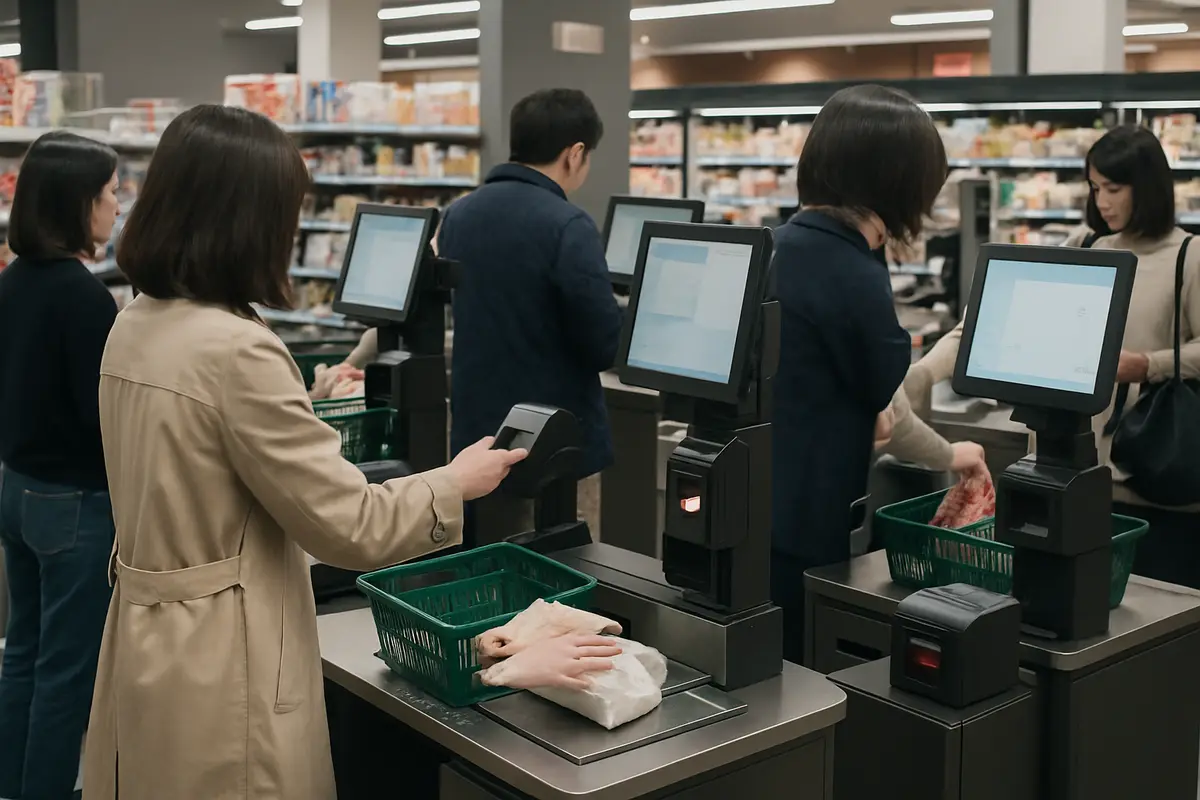
この画像はAIで生成され、学習目的で使用されています。
This image is AI-generated and used for educational purposes.
日本のスーパーやコンビニで、セルフレジが増えています2。セルフレジは、客が自分で商品の値段を機械に入れて、お金を払うレジです3。店の人はレジに立ちません4。
店がセルフレジを使う理由は、働く人が足りないからです5。日本では若い人が少なくなっています6。セルフレジがあると、少ない人で店を開けることができます7。
しかし、問題もあります8。お年寄りには、機械の使い方が難しいです9。ですから、店の人が近くにいて、使い方を教えます10。これから、もっと簡単なセルフレジが必要です11。
Discussion
to rate or comment.
No comments yet.