Expresses the means by which something is achieved — through sport, everyone can live together.
スポーツによって一緒に生きていけます。
Through sports we can live together.
インターネットによって情報が広がります。
Information spreads via the Internet.
~つつある
N2
to be in the process of
A written-style expression for a change that is gradually progressing. Here fish that used to be caught are gradually disappearing.
この習慣は消えつつある。
This custom is gradually disappearing.
景気は回復しつつある。
The economy is in the process of recovering.
~一方(で)
N3
while ~ / on the other hand
Contrasts two situations happening at the same time. 不漁が続く一方 sets the collapse of northern catches against the arrival of southern fish, and 一方で opens the paragraph on aquaculture as the other side of the story.
不漁が続く一方、南の魚が増えています。
While poor catches continue, southern fish are increasing.
一方で、養殖に切り替える動きもあります。
On the other hand, there is also a move toward aquaculture.
~ようになる
N4
come to / reach the point where
Indicates a change in state or ability.
運転できるようになった。
Trains became able to run.
日本語が話せるようになりました。
I became able to speak Japanese.
~ている
N5
is doing, has been doing (ongoing state/action)
Expresses a continuing action or resulting state. Formed with て-form + いる. Can describe an action in progress or a state resulting from a past change.
今、ご飯を食べています。
I am eating rice now.
東京に住んでいます。
I live in Tokyo.
ドアが開いています。
The door is open.
~にとって
N3
for ~ / from the perspective of ~
Indicates a point of view or perspective. Used twice here for 'the company' and 'the Vietnamese people'.
私にとって家族は大切です。
Family is important to me.
子供にとって勉強は難しい。
Study is difficult for children.
~てくる
N4
come toward (action approaching)
Indicates motion toward the speaker or a location. Here it describes rocks flying toward people.
鳥が飛んできた。
A bird flew toward (us).
雨が降ってきた。
It started raining.
~ず(に)
N3
without doing ...
Negative connective; here 'without enduring it alone, consult right away'.
我慢せず相談する。
Consult without putting up with it.
食べずに行く。
Go without eating.
~からです
N5
it is because ~
Gives a reason at the end of a sentence. Used here to explain why gasoline prices dropped (government subsidies).
疲れた。たくさん歩いたからです。
I'm tired. It's because I walked a lot.
寒いからです。
It's because it's cold.
~として
N3
as / in the role of
Marks the role, capacity, or status in which something is treated. Used here as 特別な史跡として (as a special historic site).
先生として働く。
To work as a teacher.
プレゼントとしてもらった。
I received it as a present.
~うえ(に)
N2
on top of that / in addition
Stacks a second burden onto the first, both pointing the same way. 費用がかかるうえ adds the long development time to the heavy cost of equipment.
多額の費用がかかるうえ、時間も要します。
It costs a lot of money, and on top of that it takes time.
設備が古いうえに、人も足りません。
The equipment is old, and on top of that there are not enough people.
~られる(可能)
N4
potential form (can do)
入れられる is the potential form of 入れる — 'can put (things) in'. It describes what the furniture allows you to do.
物を入れられる家具。
Furniture you can put things into.
ここで食べられます。
You can eat here.
~ごとに
N3
each, by every ~
Indicates that something is done for every unit of the noun. Here the recovered material is separated metal by metal.
クラスごとに写真を撮ります。
We take a photo for each class.
三日ごとに薬を飲みます。
I take the medicine every three days.
1
海の温度上昇で魚の種類が変わる
Rising sea temperatures are changing which fish are caught
2
日本の近海では、水温の上昇によって獲れる魚の種類が大きく入れ替わりつつあります。
In the waters around Japan, the kinds of fish that can be caught are undergoing a major shift because of rising water temperatures.
While salmon and Japanese flying squid, long the mainstays of the northern seas, continue to see record-poor catches, yellowtail and Spanish mackerel that used to live in southern waters have come to be caught in nets off Hokkaido as well.
4
研究機関は、海面の水温がこの百年で世界平均の二倍近く上がったことが背景にあると指摘しています。
Research institutions point out that behind this lies the fact that sea-surface temperatures have risen by nearly twice the global average over the past hundred years.
5
漁業者にとって、これは単なる魚種の交代では済みません。
For fishers, this is not merely a matter of one fish species replacing another.
6
長く使ってきた漁具や漁法がそのままでは通用せず、加工場や流通の仕組みも作り直す必要があるからです。
That is because the gear and methods they have used for years no longer work as they are, and processing plants and distribution systems have to be rebuilt as well.
7
ある漁協では、水揚げが増えたブリを地元で加工し、新しい特産品として売り出す取り組みを始めました。
One fisheries cooperative has started an initiative to process locally the yellowtail whose landings have increased, and to sell it as a new local specialty.
8
一方で、養殖に切り替える動きも広がっています。
Meanwhile, a move to switch over to aquaculture is also spreading.
9
ただ、設備の投資には多額の費用がかかるうえ、高い水温に耐えられる品種の開発にも時間を要します。
However, investing in facilities costs a large sum of money, and on top of that, developing breeds that can withstand high water temperatures also takes time.
10
専門家は「変化を前提に、産地ごとに戦略を立て直すことが欠かせない」と話しています。
An expert says, "It is essential to take change as a given and rebuild strategies region by region."
海の温度上昇で魚の種類が変わる1
2026年08月23日 19:23
著者: jpreader
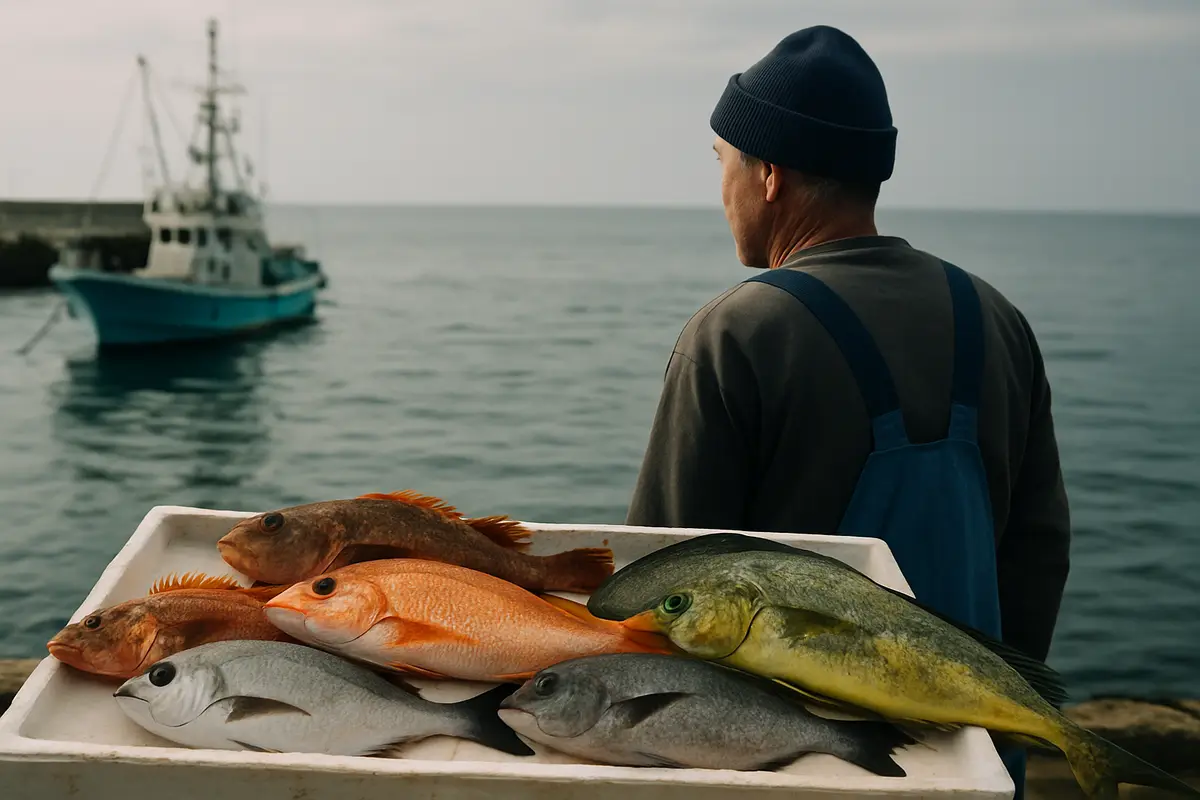
この画像はAIで生成され、学習目的で使用されています。
This image is AI-generated and used for educational purposes.
Rising sea temperatures are changing which fish are caught
2
In the waters around Japan, the kinds of fish that can be caught are undergoing a major shift because of rising water temperatures.
3
While salmon and Japanese flying squid, long the mainstays of the northern seas, continue to see record-poor catches, yellowtail and Spanish mackerel that used to live in southern waters have come to be caught in nets off Hokkaido as well.
4
Research institutions point out that behind this lies the fact that sea-surface temperatures have risen by nearly twice the global average over the past hundred years.
5
For fishers, this is not merely a matter of one fish species replacing another.
6
That is because the gear and methods they have used for years no longer work as they are, and processing plants and distribution systems have to be rebuilt as well.
7
One fisheries cooperative has started an initiative to process locally the yellowtail whose landings have increased, and to sell it as a new local specialty.
8
Meanwhile, a move to switch over to aquaculture is also spreading.
9
However, investing in facilities costs a large sum of money, and on top of that, developing breeds that can withstand high water temperatures also takes time.
10
An expert says, "It is essential to take change as a given and rebuild strategies region by region."
Discussion
to rate or comment.
No comments yet.