日本の学校で、タブレットの教科書を使うところが増えています2。国は、来年からもっと多くの学校でデジタルの教科書を使うと言いました3。
タブレットは軽いです4。だから、子どもたちのかばんが重くなりません5。動画や音も出ますから、英語の勉強に便利です6。分からない言葉はすぐに調べることができます7。
しかし、心配な人もいます8。長い時間画面を見ると、目が悪くなるかもしれません9。学校では、紙の本も一緒に使います10。先生たちは、新しい教科書の使い方を勉強しています11。
(にほん)
Japan
(がっこう)
school
(たぶれっと)
tablet
(きょうかしょ)
textbook
(つかう)
to use
(ところ)
place
(ふえる)
to increase; to grow
(くに)
country; the government
(らいねん)
next year
(もっと)
more / further
(おおい)
many
(でじたる)
digital
(いう)
to say
(かるい)
light (weight)
(だから)
so, therefore
(こども)
child
(かばん)
bag
(たち)
plural suffix (for people)
(おもい)
heavy
(どうが)
video; moving image
(おと)
sound
(でる)
to come out; to occur
(えいご)
English (language)
(べんきょう)
study
(べんり)
convenient
(わかる)
to understand, be clear
(ことば)
words, language
(すぐ)
immediately, soon
(しらべる)
to investigate; to survey
(しかし)
however, but
(しんぱい)
worry / concern
(ひと)
person / people
(ながい)
long
(じかん)
time
(がめん)
screen, display
(みる)
to see, watch
(め)
eye
(わるい)
bad
(かみ)
paper
(ほん)
book
(いっしょに)
together
(せんせい)
teacher
(あたらしい)
new
(つかいかた)
how to use; usage
is doing, has been doing (ongoing state/action)
Expresses a continuing action or resulting state. Formed with て-form + いる. Can describe an action in progress or a state resulting from a past change.
今、ご飯を食べています。
I am eating rice now.
東京に住んでいます。
I live in Tokyo.
ドアが開いています。
The door is open.
did ... (polite past)
Polite past tense of verbs. Formed with verb stem + ました. Used in formal or polite speech to describe completed actions.
昨日、映画を見ました。
I watched a movie yesterday.
朝ごはんを食べました。
I ate breakfast.
友達が来ました。
A friend came.
to become (い-adjective)
Expresses a change of state for い-adjectives. Drop the final い and add くなる. Indicates something has changed or will change to a new state.
寒くなりました。
It has gotten cold.
日本語が上手になりました。
My Japanese has gotten better.
値段が高くなりました。
The price became expensive.
because ~; since ~
Indicates the reason or cause for an action. 殺されたから攻撃した means 'attacked because they were killed'.
寒いから窓を閉めます。
Because it's cold, I'll close the window.
negative form: does not ~, will not ~
The plain negative 出ない in the headline and the polite negative 出ません in the article both say that Ohtani will not appear in the game.
オールスターゲームに出ない。
He will not play in the All-Star Game.
今年は出ません。
He will not take part this year.
can do ..., to be able to ...
Verb dictionary form + ことができる expresses ability or possibility. More formal than the potential verb form. Common in written Japanese and announcements.
日本語を話すことができます。
I can speak Japanese.
ここで写真を撮ることができます。
You can take photos here.
インターネットで予約することができます。
You can make a reservation on the internet.
if / when (natural consequence)
Conditional と indicating a natural or expected result. 一緒に捨てると…火が出て means 'if you throw them away together, fire starts.'
ボタンを押すと、ドアが開きます。
When you press the button, the door opens.
春になると、桜が咲きます。
When spring comes, cherry blossoms bloom.
might ~, perhaps ~
Expresses possibility.
明日雨が降るかもしれません。
It might rain tomorrow.
彼は来ないかもしれません。
He might not come.
学校の教科書がタブレットになる
School textbooks are becoming tablets
日本の学校で、タブレットの教科書を使うところが増えています。
In Japan, the number of schools using tablet textbooks is increasing.
国は、来年からもっと多くの学校でデジタルの教科書を使うと言いました。
The government said that from next year, digital textbooks will be used at many more schools.
タブレットは軽いです。
Tablets are light.
だから、子どもたちのかばんが重くなりません。
So children's schoolbags do not get heavy.
動画や音も出ますから、英語の勉強に便利です。
Because they also play video and sound, they are convenient for studying English.
分からない言葉はすぐに調べることができます。
You can look up words you don't understand right away.
しかし、心配な人もいます。
However, there are also people who are worried.
長い時間画面を見ると、目が悪くなるかもしれません。
If you look at a screen for a long time, your eyesight might get worse.
学校では、紙の本も一緒に使います。
At school, paper books are used alongside them as well.
先生たちは、新しい教科書の使い方を勉強しています。
Teachers are studying how to use the new textbooks.
2026年08月30日 19:10
著者: jpreader
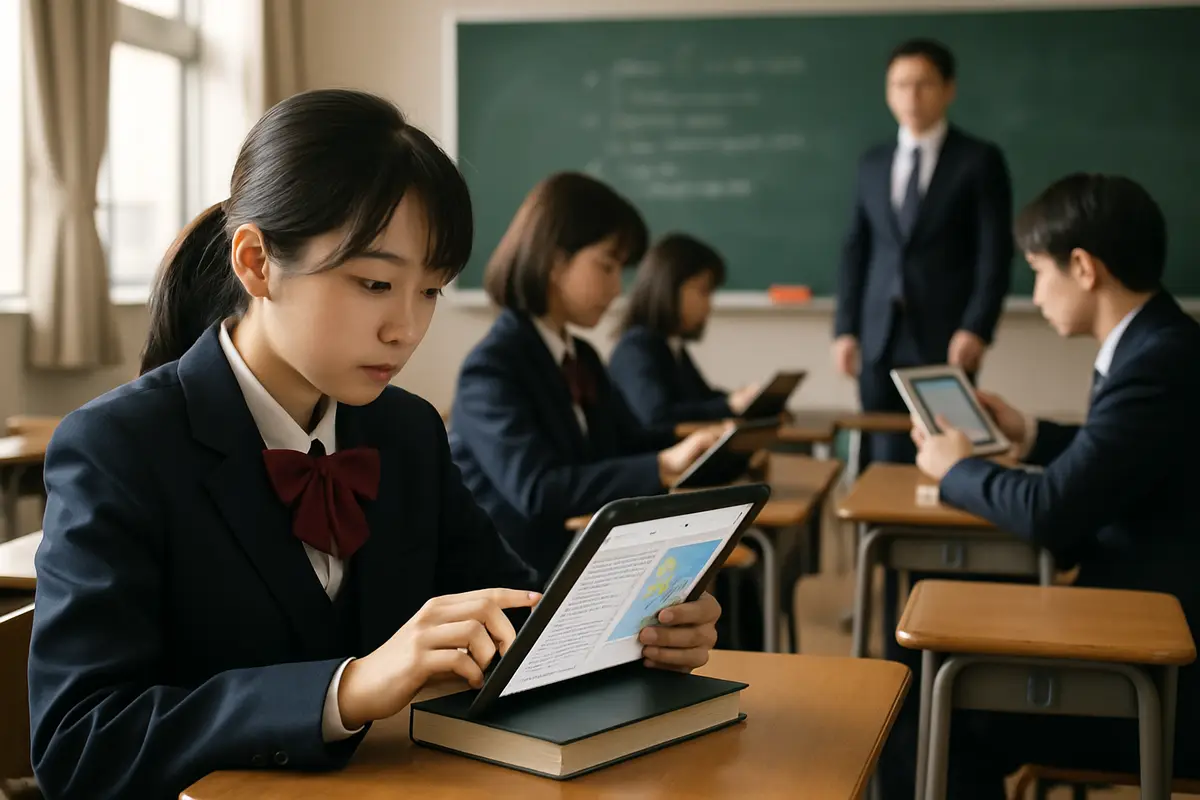
この画像はAIで生成され、学習目的で使用されています。
This image is AI-generated and used for educational purposes.
日本の学校で、タブレットの教科書を使うところが増えています2。国は、来年からもっと多くの学校でデジタルの教科書を使うと言いました3。
タブレットは軽いです4。だから、子どもたちのかばんが重くなりません5。動画や音も出ますから、英語の勉強に便利です6。分からない言葉はすぐに調べることができます7。
しかし、心配な人もいます8。長い時間画面を見ると、目が悪くなるかもしれません9。学校では、紙の本も一緒に使います10。先生たちは、新しい教科書の使い方を勉強しています11。
Discussion
to rate or comment.
No comments yet.