Expresses a continuing action or resulting state. Formed with て-form + いる. Can describe an action in progress or a state resulting from a past change.
今、ご飯を食べています。
I am eating rice now.
東京に住んでいます。
I live in Tokyo.
ドアが開いています。
The door is open.
~れる/~られる(受身)
N4
passive form
The passive marks the subject as the one affected. 頭を打たれる means having your head struck by something.
落ちてきた物に頭を打たれます。
Your head gets struck by a falling object.
先生にほめられました。
I was praised by the teacher.
疑問詞+でも
N4
any- (anyone, anything, anywhere)
A question word plus でも means "no matter which one." だれでも来られる場所 is a place that anyone at all can come to, which is the point the article makes about how the cafeterias have changed.
何でも食べられます。
I can eat anything.
いつでも来てください。
Please come any time.
~ように
N4
so that ~
Indicates a goal or desired outcome. Here: so that trainees reach the Specified Skilled Worker level.
分かるように説明します。
I'll explain so you understand.
聞こえるように大きい声で話す。
Speak loudly so it can be heard.
~によると
N3
according to ...
Cites a source of information. The noun before によると is the source. Often followed by a reported statement.
天気予報によると、明日は雨です。
According to the weather forecast, it will rain tomorrow.
ニュースによると、地震がありました。
According to the news, there was an earthquake.
先生によると、テストは来週です。
According to the teacher, the test is next week.
~だけでは
N4
just with ~ alone (is not enough)
Expresses that acting by themselves alone is insufficient to handle the bear problem.
一人だけでは無理です。
It's impossible alone.
お金だけでは幸せになれない。
You can't be happy with just money.
~という
N4
called/named ~
Used to introduce or name something. In this article, 「鳥貴族」という店 means 'a store called Torikizoku'.
田中という人を知っていますか。
Do you know a person called Tanaka?
これは寿司という料理です。
This is a dish called sushi.
~ことで
N3
By doing; through the act of
Indicates that the preceding action serves as a means or cause for what follows. 'アメリカとウクライナが一緒に開発することで' means 'by developing together'.
運動することで、健康になります。
By exercising, you become healthy.
~やすい
N4
easy to ~ / tends to ~
Used in 'うつりやすくて' meaning 'easily contagious / easy to catch'.
この本は読みやすい。
This book is easy to read.
忘れやすい。
Easy to forget.
~そうだ(伝聞)
N4
I hear that / it is said
Reports hearsay. 大きく育つそうです means '(I hear) they grow big'.
雨が降るそうだ
I hear it will rain
おいしいそうだ
they say it's delicious
~こと(名詞化)
N4
nominalizer (the act of ~)
Turns verbs into nouns — changing one's awareness (意識を変えること), not over-buying (買いすぎないこと), and using leftovers well (使うこと).
走ることが好きだ。
I like running.
話すことが大切だ。
Talking is important.
~さ(形容詞の名詞化)
N3
-ness: turns an adjective into a noun
An i-adjective drops い and takes さ to name the quality itself. 難しい becomes 難しさ, 'the difficulty', which is what the writer calls the real challenge.
続けることの難しさだ。
It is the difficulty of keeping it going.
川の水の冷たさに驚いた。
I was surprised at the coldness of the river water.
疑問詞+か(間接疑問)
N3
embedded question: how / who / what ~
A question word plus か wraps a question inside a larger sentence, where it works as a noun phrase. 若い世代をどう誘うか, 'how to attract younger generations', is itself the problem.
どう誘うかが問題になっている。
How to invite them has become the problem.
誰が測るか決めましょう。
Let's decide who will do the measuring.
~になっている
N4
has become ~; is now ~
Describes a current state resulting from change — 'AI は道具になっている' means AI has become a tool.
AIは大切な取り引きの道具になっていると言っています。
They say AI has become an important trading tool.
1
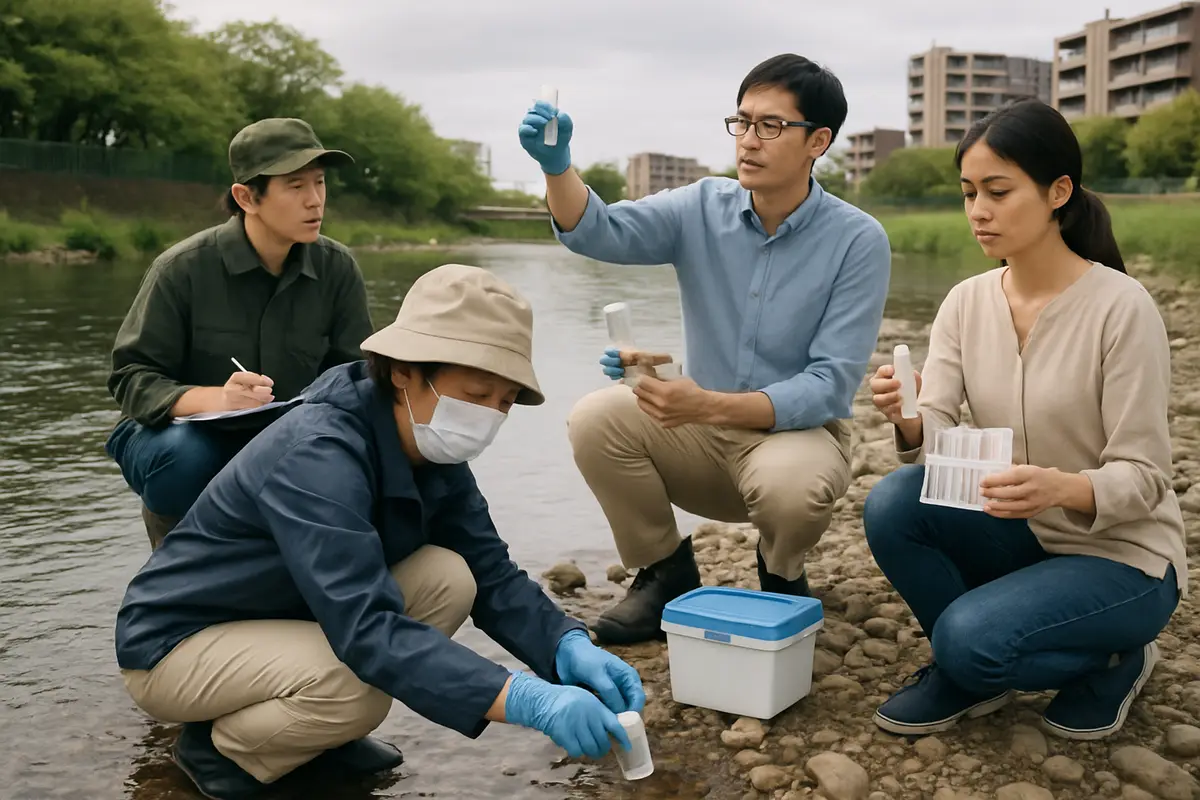
市民が川の水質を調べる活動が広がる
Citizen activities to test river water quality are spreading
2
各地で、住民が自分たちの手で川の水質を調べる活動が広がっている。
In many parts of the country, activities in which residents test the water quality of rivers with their own hands are spreading.
3
参加者は簡単な検査キットを使い、決められた場所で毎月水を採る。
Participants use a simple testing kit and collect water each month at designated spots.
4
結果は地図の形でまとめられ、誰でも見られるように公開されている。
The results are compiled in the form of a map and made public so that anyone can see them.
5
この取り組みを進める団体によると、行政の調査だけでは、細かい変化までは分からないという。
According to the group promoting this effort, government surveys alone do not reveal small changes.
6
住民が同じ地点を長く測り続けることで、工事や大雨の影響が現れやすくなる。
By having residents keep measuring the same spot over a long period, the effects of construction work and heavy rain become easier to see.
7
実際に、汚れの原因が見つかった例もあるそうだ。
In fact, there are reportedly cases in which the cause of the pollution was found.
8
課題は続けることの難しさだ。
The challenge is the difficulty of keeping it going.
9
参加者の多くは高齢で、若い世代をどう誘うかが問題になっている。
Many of the participants are elderly, and how to draw in younger generations has become a problem.
10
ある団体は、学校の授業に検査を取り入れ、子どもと一緒に活動する方法を試している。
One group is trying a method of bringing the testing into school classes and doing the activity together with children.
市民が川の水質を調べる活動が広がる1
2026年09月06日 19:24
著者: jpreader
この画像はAIで生成され、学習目的で使用されています。
This image is AI-generated and used for educational purposes.
Discussion
to rate or comment.
No comments yet.