Ministry of Education, Culture, Sports, Science and Technology
事例
N2
(じれい)
case, worked example
紹介
N3
(しょうかい)
introduction, presentation
自治体
N1
(じちたい)
local government / municipality
支援
N2
(しえん)
support; aid; assistance
~ている
N5
is doing, has been doing (ongoing state/action)
Expresses a continuing action or resulting state. Formed with て-form + いる. Can describe an action in progress or a state resulting from a past change.
今、ご飯を食べています。
I am eating rice now.
東京に住んでいます。
I live in Tokyo.
ドアが開いています。
The door is open.
受身形(~われる・~される)
N4
passive: to be done (to something)
The passive turns the object into the subject, so the doer disappears. 使われなくなった校舎 and 避難所に利用されています both describe what happens to the buildings without naming who does it.
使われなくなった校舎が増えました。
School buildings that are no longer used have increased.
体育館は避難所に利用されています。
The gymnasium is used as an evacuation shelter.
~として
N3
as / in the role of
Marks the role, capacity, or status in which something is treated. Used here as 特別な史跡として (as a special historic site).
先生として働く。
To work as a teacher.
プレゼントとしてもらった。
I received it as a present.
~にする
N4
decide on / make it X
Indicates choice or theme. Here makes SF and LGBTQ the themes.
コーヒーにします
I'll have coffee.
テーマにする
make it the theme
動詞+名詞(連体修飾)
N4
a verb clause modifying a noun
Japanese puts a whole clause in plain form directly in front of the noun it describes. 閉校した学校 = 'a school that has closed'; 閉校した小学校 works the same way.
閉校した学校が地域の拠点に変わる。
Schools that have closed are becoming community hubs.
閉校した小学校の教室を貸し出しています。
They rent out the classrooms of an elementary school that has closed.
~て(動作をつなぐ)
N5
and then ~ (te-form linking)
The te-form links successive actions in one sentence. 置いて connects placing the clothes with comparing their temperature, and 考えて connects thinking with choosing.
朝起きて、顔を洗います。
I get up in the morning and wash my face.
よく考えて決めてください。
Please think carefully and decide.
~や
N5
and (non-exhaustive list)
や lists representative examples — Shikoku and Kyushu among other regions (四国や九州).
りんごやみかんを買った。
I bought apples and oranges (among others).
東京や大阪は大きい都市だ。
Tokyo and Osaka are big cities.
~ます
N5
polite non-past tense
The polite non-past ~ます states what will happen — the funeral will continue.
葬式は続きます。
The funeral will continue.
明日行きます。
I will go tomorrow.
~です
N5
polite copula / is, am, are
Describes states such as the mother panda being healthy and the baby being small.
これは本です。
This is a book.
今日は寒いです。
It is cold today.
~ません
N5
does not ~ (polite negative)
ません is the polite negative form of verbs. It negates the action in a formal/polite context.
今日は学校に行きません。
I won't go to school today.
1
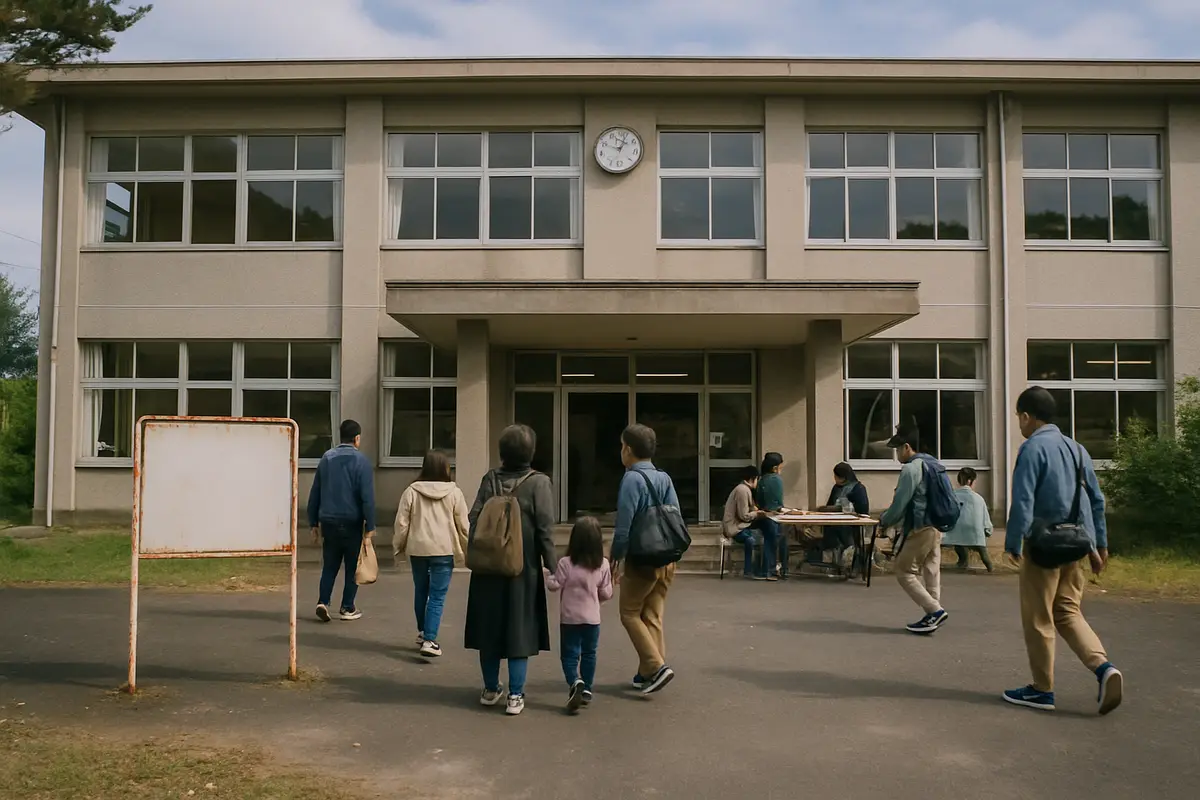
閉校した学校が地域の拠点に変わる
Closed schools are turning into community hubs
2
子どもの数が減り、全国で学校の統廃合が進んでいます。
The number of children is falling, and school mergers and closures are advancing across the country.
3
使われなくなった校舎をそのまま残すと、管理の費用がかかります。
If a school building that is no longer used is simply left standing, it costs money to maintain.
4
そこで、地域の新しい拠点として活用する動きが各地で広がっています。
So a movement to put such buildings to use as new community hubs is spreading around the country.
5
ある町では、閉校した小学校の教室を企業の事務所として貸し出しています。
In one town, the classrooms of a closed elementary school are rented out as company offices.
6
体育館はスポーツ教室や避難所に利用されています。
The gymnasium is used for sports classes and as an evacuation shelter.
7
給食室を改装して、地元の野菜を使った食品を作る工場にした例もあります。
There is also a case where the school kitchen was remodelled into a factory making food from local vegetables.
8
課題は費用と人材です。
The challenges are cost and staffing.
9
古い建物は耐震工事が必要な場合が多く、運営を続ける人も欠かせません。
Old buildings often need earthquake-proofing work, and people to keep them running are indispensable as well.
10
文部科学省は活用の事例を紹介して、自治体を支援しています。
The Ministry of Education introduces examples of such reuse and supports local governments.
閉校した学校が地域の拠点に変わる1
2026年09月09日 19:27
著者: jpreader
この画像はAIで生成され、学習目的で使用されています。
This image is AI-generated and used for educational purposes.
Discussion
to rate or comment.
No comments yet.