(こうしゅうでんわ)
public telephone, pay phone
(へる)
to decrease / to diminish
(けす)
to extinguish, to turn off
(けいたいでんわ)
mobile phone; cell phone
(ひろまる)
to spread, to become widespread
(つうしんがいしゃ)
telecommunications company
(のこす)
to leave behind, to leave uneaten
(かたづける)
to tidy up, to clean up
(いっぽう)
on the other hand / meanwhile
(つながる)
to be connected, to link up
(ていでん)
power outage / blackout
(ふえる)
to increase; to grow
(じゅわき)
telephone receiver, handset
(じゅんばん)
order; turn; ranking
(れんしゅう)
practice, training
(せんもんか)
expert, specialist
(たしかめる)
to make sure; to confirm
is doing, has been doing (ongoing state/action)
Expresses a continuing action or resulting state. Formed with て-form + いる. Can describe an action in progress or a state resulting from a past change.
今、ご飯を食べています。
I am eating rice now.
東京に住んでいます。
I live in Tokyo.
ドアが開いています。
The door is open.
because of, due to
Indicates a reason or cause. More formal than から or ので. Can follow nouns (の + ため) or plain-form verbs/adjectives.
病気のため、学校を休みました。
I was absent from school because of illness.
雨が降ったため、試合は中止です。
The game was cancelled because it rained.
勉強するため、図書館に行きます。
I go to the library in order to study.
it is because ~
Gives a reason at the end of a sentence. Used here to explain why gasoline prices dropped (government subsidies).
疲れた。たくさん歩いたからです。
I'm tired. It's because I walked a lot.
寒いからです。
It's because it's cold.
only ~
Limiter particle. 女性だけが宇宙船に乗りました means 'only women boarded the spaceship.'
水だけ飲みました。
I only drank water.
and / by doing (means)
The te-form connects clauses; here it expresses the means by which the teacher creates problems (by using AI).
電車に乗って行きます。
I will go by train.
辞書を使って調べます。
I look it up using a dictionary.
it is said that ~
Passive form expressing common knowledge or reputation. It is said that aquaculture of nodoguro is difficult.
難しいと言われています。
It is said to be difficult.
日本語は難しいと言われています。
It is said that Japanese is difficult.
if / when (natural consequence)
Conditional と indicating a natural or expected result. 一緒に捨てると…火が出て means 'if you throw them away together, fire starts.'
ボタンを押すと、ドアが開きます。
When you press the button, the door opens.
春になると、桜が咲きます。
When spring comes, cherry blossoms bloom.
hard to ~; difficult to ~
Attached to a verb stem to describe difficulty — 'people who have difficulty hearing'.
because ~ / since ~
Causal connector. Because JA is buying at higher prices, store prices will also rise.
雨が降ったので、家にいた。
Since it rained, I stayed home.
忙しいので、行けません。
Since I'm busy, I can't go.
Even ~; also at ~
Particle でも after a noun means 'even' or 'also at.' 首相官邸の庭でも means 'even at the Prime Minister's residence garden.'
子供でもわかります。
Even a child can understand.
potential form: can do ~
使う becomes 使える to say the phones can still be used: 停電のときでも使えます.
停電のときでも使えます
You can use them even during a blackout
ここから富士山が見えます
You can see Mt. Fuji from here
to become
Expresses a change of state; Kawai became the new commissioner of the Sports Agency.
新しい長官になりました。
He became the new commissioner.
目が見えなくなりました。
He became unable to see.
there are cases where / sometimes
Indicates a possible downside: 給料が下がる場合もあります (there are cases where pay goes down).
給料が下がる場合もあります。
There are cases where pay goes down.
遅れる場合があります。
There are cases of being late.
way of doing
Attached to verb stem to mean 'way of doing'. '力の入れ方' means 'way of applying force'.
食べ方が分からない。
I don't know how to eat it.
書き方を教えてください。
Please teach me how to write.
negative form: does not ~, will not ~
The plain negative 出ない in the headline and the polite negative 出ません in the article both say that Ohtani will not appear in the game.
オールスターゲームに出ない。
He will not play in the All-Star Game.
今年は出ません。
He will not take part this year.
after doing ...
Expresses a sequence where one action is completed before the next begins. Formed with て-form + から. Emphasizes completion of the first action.
ご飯を食べてから、出かけます。
After eating, I will go out.
手を洗ってから、食べてください。
Please eat after washing your hands.
日本に来てから、3年が過ぎました。
Three years have passed since coming to Japan.
Do ~ in advance (preparation)
Indicates doing something in advance for future readiness. Companies need to decide procedures in advance.
旅行の前にホテルを予約しておく。
I book a hotel in advance before the trip.
is saying that ..., is talking about ...
Quotation と + 話している. Used to report what someone is saying in speech. Similar to と言っている but slightly more formal.
社長は新しい計画について話しています。
The president is talking about the new plan.
彼女は将来の夢について話していました。
She was talking about her future dreams.
1
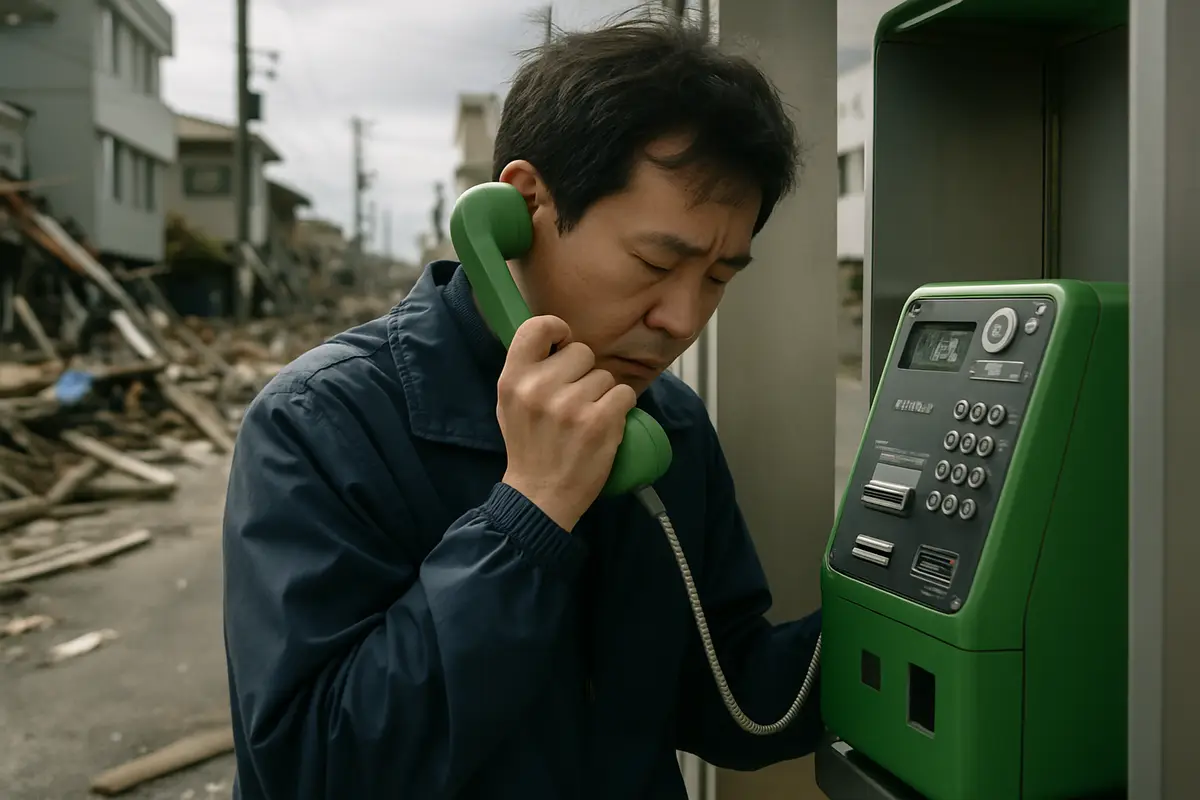
公衆電話が減る中で災害時の役割に注目
As public telephones disappear, attention turns to their role in a disaster
2
街の中から公衆電話が少しずつ姿を消しています。
Public telephones are gradually disappearing from the streets of towns.
3
携帯電話が広まったため、使う人が大きく減ったからです。
That is because mobile phones have become widespread and the number of people who use them has dropped sharply.
4
通信会社は必要な数だけを残して、それ以外を片づけています。
Telecom companies are keeping only as many as are needed and removing the rest.
5
一方で、災害の時には公衆電話が役に立つと言われています。
On the other hand, public telephones are said to be useful in times of disaster.
6
大きな地震が起きると、携帯電話はつながりにくくなります。
When a big earthquake happens, mobile phones become hard to get through on.
7
公衆電話は電話線から電気をもらうので、停電のときでも使えます。
Public telephones draw their power from the telephone line, so they can be used even during a blackout.
8
災害のときは無料になる場合もあります。
In a disaster there are also cases where they become free of charge.
9
ただ、使い方を知らない若い人も増えています。
However, the number of young people who do not know how to use them is also increasing.
10
そのため、学校や地域では、受話器を取ってからお金を入れる順番を教える練習をしています。
For that reason, schools and local communities are running practice sessions that teach the order — pick up the receiver first, then put in the money.
11
専門家は、家の近くにある公衆電話の場所を、家族で確かめておくことが大切だと話しています。
Experts say it is important for families to check in advance where the public telephones near their home are.
Discussion
to rate or comment.
No comments yet.