Expresses an attempt/intention. Used to say China 'was about to / trying to' tighten rare earth exports.
出かけようとしたとき、電話が鳴った。
Just as I was about to go out, the phone rang.
問題を解決しようとしている。
They are trying to solve the problem.
~ようにしておく
N3
to arrange in advance so that ~
Combines ようにする (make it so that) with ておく (do in advance) in the expert's advice: 現金も使えるようにしておくことが大切です.
現金も使えるようにしておきます
We keep things so that cash can be used too
すぐ読めるようにしておいてください
Please set it up in advance so it can be read right away
~やすい
N4
easy to ~ / tends to ~
Used in 'うつりやすくて' meaning 'easily contagious / easy to catch'.
この本は読みやすい。
This book is easy to read.
忘れやすい。
Easy to forget.
~なくなる
N4
to become no longer / to disappear
Indicates a change where something ceases to exist or can no longer be done. Here it describes that prayer gatherings can no longer be held in Hong Kong.
お金がなくなった。
The money is gone.
痛みがなくなりました。
The pain went away.
~なくてもいい
N4
it's okay not to ~; don't have to ~
Expresses that there is no obligation or necessity to do something.
何もしなくてもいいです。
You don't have to do anything.
~てくる
N4
come toward (action approaching)
Indicates motion toward the speaker or a location. Here it describes rocks flying toward people.
鳥が飛んできた。
A bird flew toward (us).
雨が降ってきた。
It started raining.
~にとって
N3
for ~ / from the perspective of ~
Indicates a point of view or perspective. Used twice here for 'the company' and 'the Vietnamese people'.
私にとって家族は大切です。
Family is important to me.
子供にとって勉強は難しい。
Study is difficult for children.
~ている
N5
is doing, has been doing (ongoing state/action)
Expresses a continuing action or resulting state. Formed with て-form + いる. Can describe an action in progress or a state resulting from a past change.
今、ご飯を食べています。
I am eating rice now.
東京に住んでいます。
I live in Tokyo.
ドアが開いています。
The door is open.
~という
N4
called/named ~
Used to introduce or name something. In this article, 「鳥貴族」という店 means 'a store called Torikizoku'.
田中という人を知っていますか。
Do you know a person called Tanaka?
これは寿司という料理です。
This is a dish called sushi.
~ないで
N4
without doing; don't do
Negative te-form used to indicate doing something without another action, or as a soft command.
朝ご飯を食べないで学校に行きました。
I went to school without eating breakfast.
心配しないでください。
Please don't worry.
~と(条件)
N4
if / when (natural consequence)
Conditional と indicating a natural or expected result. 一緒に捨てると…火が出て means 'if you throw them away together, fire starts.'
ボタンを押すと、ドアが開きます。
When you press the button, the door opens.
春になると、桜が咲きます。
When spring comes, cherry blossoms bloom.
~ない(連体)
N5
plain negative modifying a noun
The plain negative 足りない sits in front of 町 to describe it: お金が足りない町 (towns where money is short).
お金が足りない町では、まだできません
In towns where money is short, it still cannot be done
人が来ない図書館
a library that nobody comes to
1
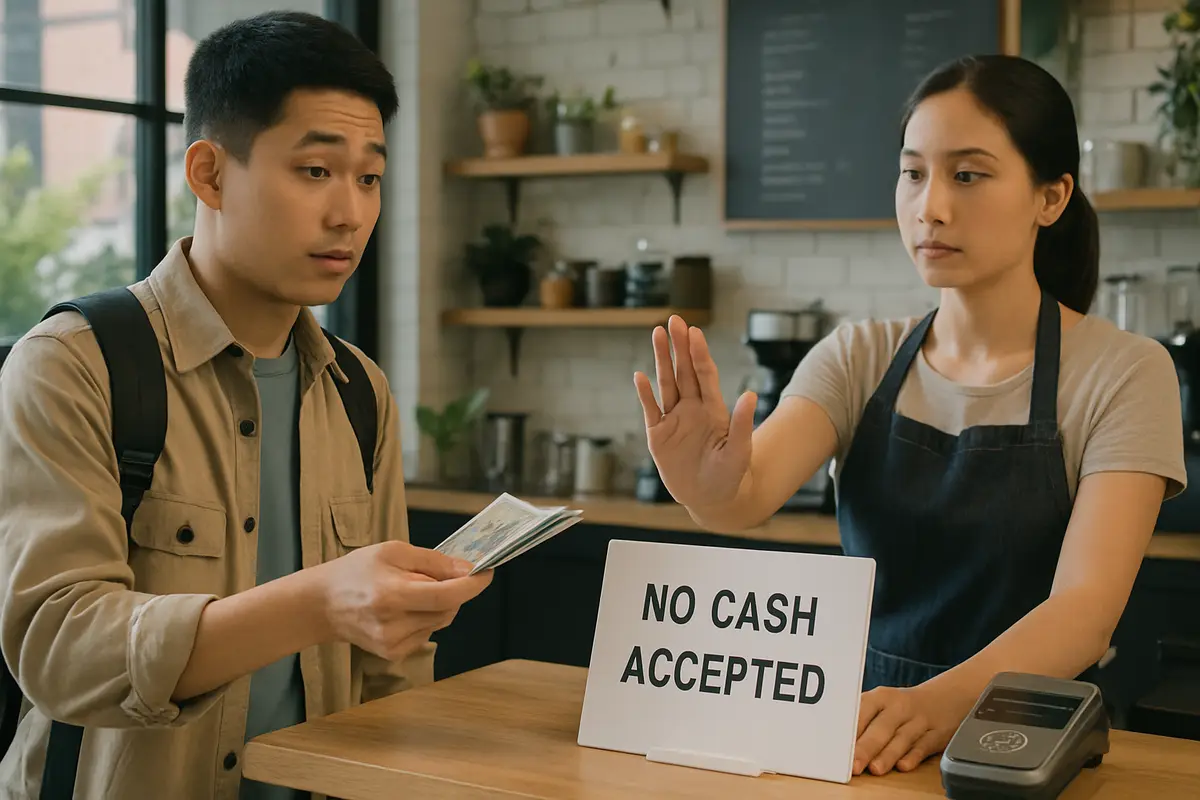
現金を使わない店が広がる
Cashless shops are spreading
2
日本では、現金を使わない店が少しずつ増えています。
In Japan, shops that do not take cash are gradually increasing.
3
客はスマートフォンやカードで料金を払います。
Customers pay the charge with a smartphone or a card.
4
店にとっては、お金を数える時間が短くなるという利点があります。
For the shops there is the advantage that the time spent counting money becomes shorter.
5
政府も、支払いのデジタル化を進めようとしています。
The government, too, is trying to push forward the digitalization of payments.
6
外国から来た観光客は、日本のお金を用意しなくてもいいので、買い物がしやすくなります。
Tourists who come from abroad do not have to prepare Japanese money, so shopping becomes easier for them.
7
若い人を中心に、財布を持たないで出かける人も増えてきました。
Mainly among young people, the number who go out without carrying a wallet has been growing.
8
一方で、心配する声もあります。
On the other hand, there are also voices of concern.
9
高齢者の中には、スマートフォンの操作が苦手な人もいます。
Among elderly people there are some who are not good at operating a smartphone.
10
また、停電や通信の故障が起きると、支払いができなくなります。
Also, if a power outage or a communications failure occurs, payment becomes impossible.
11
専門家は「現金も使えるようにしておくことが大切です」と話しています。
Experts say, "It is important to keep things set up so that cash can be used as well."
現金を使わない店が広がる1
2026年09月14日 19:06
著者: jpreader
この画像はAIで生成され、学習目的で使用されています。
This image is AI-generated and used for educational purposes.
Discussion
to rate or comment.
No comments yet.